
Stellenbosch Students Innovate to Save Water
Impacted by a severe drought since 2015, South Africa’s Western Cape is running out of water. The looming crisis affects everyone in the region, including its many world-class scientists and scientific institutions. Nature has recently covered the drought's impacts on research and public health.
While the Western Cape waits for rain, we wanted to highlight a story about how one of our Instrumental Access awardees is adapting and innovating.
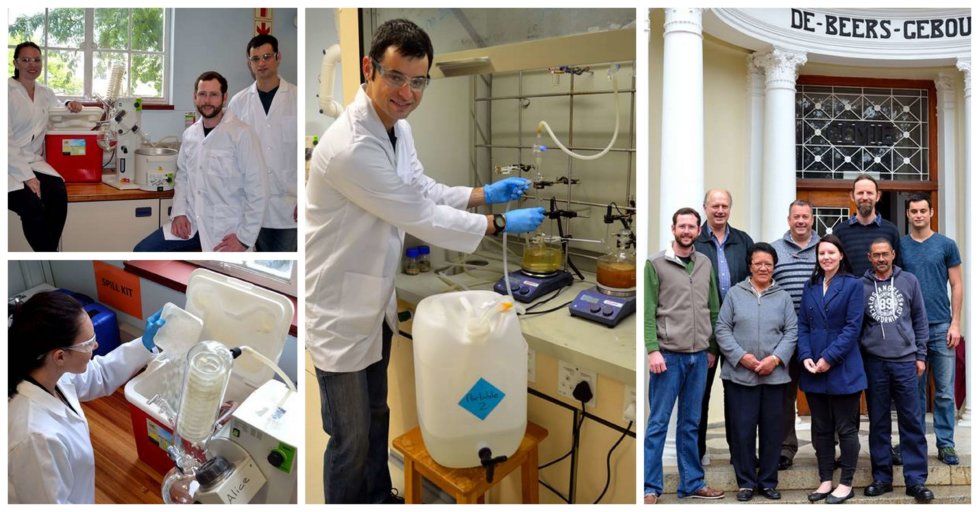
The Department of Chemistry and Polymer Sciences at Stellenbosch University has implemented a new system designed by a group of PhD students to conserve water in the chemistry lab.
Their effective, low-cost solution for recycling water involves a cooler, garden hose, laboratory silicon tubing, and a small garden fountain pump.
It is now being used by every laboratory in the department with the instruments that typically consume the most water—including the two rotary evaporators that were part of their 2015 Instrumental Access shipment!
The Department of Chemistry and Polymer Sciences has also installed enough reverse osmosis systems over the past several years to drastically reduce their water usage when purifying water for reactions.
"The old boiler systems used to waste 800L for every 80L distilled. With seven of them in the department you can imagine how much water that was weekly! We now use very simple reverse osmosis systems that only use 5 to 10L of water to flush the system for every 100L of type II water produced."Peta Steyn, Principal Technical Officer
Learn more about this innovation:
- "Chemistry students save 3000 litres of water per week in lab," from Stellenbosch University News
- Royal Society of Chemistry coverage: An article by the inventors Monica Clements, Jonathan Hay, and Anton Hamann, all PhD students in the department of chemistry and polymer science
- Watch a video featuring Jonathan Hay
Share this Post